Showing posts with label Animation. Show all posts

23 March 2006

Bon Voyage, Charlie Brown (and Don't Come Back!) (1980)


Charlie Brown is your typical everyday kid. He has trouble with the girls, his baseball team has a very consistent loosing streak, he cowers in fear of a kite-eating-tree, and his dog has a strange obsession of flying his red 'Sopwith Camel' dog house. Well, maybe he isn't your average kid, but the blockhead and his friends have been entertaining children and adults alike since 1950. Needless to say, the comic series has spawned much commercial interest, including four feature length films.

The last of the four films, Bon Voyage, Charlie Brown (and Don't Come Back!) (1980), throws good ol' Chuck into yet another sticky situation that will require his intelligence, wit, and friends to get out of (we're doomed). This time, Charlie Brown (Arrin Skelley) and his classmates Linus van Pelt (Daniel Anderson), Peppermint Patty (Laura Planting), and Marcie (Casey Carlson) manage to become foreign exchange students to the town of Le Heron in France. Another surprise awaits Chuck at home: his very first letter. Except it's in French. Know-it-all Marcie translates the letter for Chuck, revealing that he has been invited to the Château Mal Voisin, or the Château of the Bad Neighbor [dramatic cord].

After a round of tennis at Wimbledon, the gang leaves England and arrives at France. Peppermint Patty and Marcie are dropped off (they're staying with a different host, because they go to a different school), and Chuck, Linus, Snoopy and Woodstock arrive at the Château of the Bad Neighbor [dramatic cord]. With no one to great them but locked doors, bad weather, and rumors of the ill tempered Baron (not to be confused with Snoopy's archenemy, the Bloody Red Baron), the gang is forced to camp outside. Mystery continues though, and it seems as if no one is safe. Who sent the letter, and why are they locked out of the Château? Who mysteriously gives them food and blankets under the cover of night? Why does the Baron hate foreigners? How come Charlie Brown is such a blockhead? Most importantly, why can't I have a normal dog like everybody else? Although the film was created to teach young children about countries overseas, Bon Voyage manages to brilliantly combine the educational lesson with the original story, resulting in a simple, yet great, family film.

The majority of the film, although a family film, is symbolic. For example, the town name Le Heron is the most obvious case, representing a heron (and as Marcie says, "That's a bird, a big bird Chuck"). However, as stated earlier, the film is intended to teach children about England and France, so all town names (including Le Heron) are real places. The heron usually is an omen for good luck and prosperity, something that the town could definitely use, but can also be warning of fire. Indeed, this foreboding does come true at the end of the film, and Charlie Brown must use his instincts to save Linus and the resident of the Château. Another aspect of the symbolism revolves around the Baron. The Baron has a very negative inclination towards everyone, especially foreigners. As this is a mystery, the dark atmosphere is kept up with the almost constant rain that pours over the Château. The Baron's negative feeling towards everyone seems to have materialized in the form of the bad weather, as proven towards the end of the film, with the elimination of the bad feeling and weather. Unfortunately, the heron's warning of fire is ignored, and the Château is tragically set on fire. Fire is symbolic of a cleansing, such as the mental cleansing of the Baron's attitude. Once the fire is over, the Baron apologizes for his behavior as a bad neighbor, and decides to turn over a new leaf.

Although the Baron is never really shown, along with most adults, the Peanut tradition is broken for the first time, and possibly only time, as an English speaking (and French speaking) adult is shown speaking. When Charles Schulz created Peanuts, he wanted to show it through the world of a child. Therefore, adults are never shown, and when speaking say the trademark "Wah wah wah". The new introduction of adults into the world of Peanuts could be a cultural view of adults across the sea. Adults here could be viewed as uncaring in their children's lives, while the 'foreign' counterparts are shown because they care. The Baron, someone who obviously doesn't take an active role in his daughter's life, is never shown. However, the caring grandparents who always allow a second cookie are shown in memories, such as photographs. (Charlie Brown's grandfather is shown, and we finally learn that his baldness is genetic)

When the inevitable fire occurs, both Charlie Brown and the Baron have similar reactions. They (quite literally) run around in circles, screaming for help. Charlie Brown, however, shows initiative and runs around in circles looking for help. In fact, all of the children show initiative, and the only reason the Château survives is because of the children. If it wasn't because of Charlie Brown's quick thinking (and running), the Château, and Linus would be forever gone.

The climax of the film, the Château ablaze, is one of the most beautifully put together scenes I have ever seen. The artwork, music, and lines are all magnificent and haunting, simple yet complex, and create an awe inspiring feeling to anyone who views it. This is very appropriate, for fire should create the same feeling, especially when the fire threatens someone's life. The most poignant part is when the Château is viewed from the house of Peppermint Patty and Marcie. Although seen from a distance, the flames are easily visible, and the thought of someone encased in that torturous situation is as intense as the heat.

The symbolism continues even as the film ends, while the credits role. The three countries featured in the film, America, England, and France, coincidentally share the same colors on the flag (red, white, and blue). While the credits role, the three colors mix and combine, showing a friendship and unity between the three countries. This is the main theme of the film after all, as shown by the Baron's 'friendly' attitude throughout the film.

When viewing the film, you should of course remember this is a family film intended to teach children about France and England. Many lines are repeated over and over again for the benefit of the small children minds watching it. Also, long drawn out scenes are common, as it is supposed to show the architecture of France, or even the technology of England. However, ignoring this if you choose (I learned many new things from the film), the film is very simple and beautiful, exciting blockheads of every age. The characters, places, and symbolism will stay with you for a while after the film, such as the Peanuts gang has done since 1950, including the adventures and lessons that everyone had at the Château of the Bad Neighbor [dramatic cord].

05 January 2006

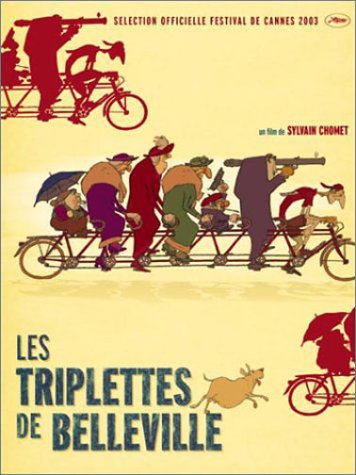
Les Triplettes de Belleville (2003)


In an interesting follow-up to the previous post (King Kong (2005)), this film completely contradicts the main theme of 'look without your eyes' that is discussed in King Kong (2005). The French film, Les Triplettes de Belleville (2003) (also known as The Triplets of Belleville), contains no spoken words, except for the French television announcers or random phrases said by extremely minor characters (of which, there are no subtitles, so I have no idea what they are saying). Of course, this doesn't matter, for director Sylvain Chomet has animated this film in a way that every character can be characterized on their visual appearance. One of the most interesting aspects of Les Triplettes de Belleville is the unusual caricature that each person has. This technique becomes very important to the director through the film, because it helps the characters vocalize what they might say.

Young Champion has had a miserable life. After the death of his parents, he is sent to live with his Grandmother, Madame Souza. Although she tries her best to cheer up her grandson, with everything from a dog named Bruno to a Piano, Champion still remains depressed. One day, however, Madame Souza brings home a tricycle, and life begins to change. Years later, Champion has matured into the typical caricature of a cyclist: a person that resembles a racing horse. Cycling has now become a major part of this small family's life. Madame Souza is now the trainer of Champion, and does everything from maintain the diet of her grandson, to the literal fine tuning of the bicycle wheels. Champion, now an excellent cyclist, signs up for the Tour de France. However, the trouble begins when the French Mafia kidnaps him halfway through the race.

Madame Souza, determined to rescue her grandson, rents a paddle boat and follows him across the Atlantic Ocean (that's determination) to the city of Belleville. There, Souza meets up with the Triplets, a once famous singing group. The four become quick friends, and set out to try and rescue the kidnapped cyclists, using their keen minds, their great determination, and Bruno's nose. (Watch out French Mafia, you have four old ladies and a dog after you, and their armed with iron cooking pans)

As said earlier, the most interesting part of the film was how the director displayed the different people in the film. The mechanic, who is always sneaking in and out of small, tiny spaces, is depicted as a mouse. The grandmother has the stereotypical qualities that you would expect a grandmother to have (short, old, glasses, etc.). The cyclists are the most interesting of all, as they are depicted as racing horses, who look, sound, and even act like an animal (one cyclist is 'put out of his misery). Even caricatures of famous people, such as
Charlie Chaplin and Jacques Anquetil appear in the film. Using these caricatures, the director conveys the qualities, emotion, and characteristics of each person without using any vocals to assist him. This, of course, gives the film a very 'cartoonish' feel to the film, because no one is shaped like a cereal box in real life. Another task that is fulfilled with this process is that the director can display his own views on society with the caricatures. For example, since all the city folk are displayed as really, really, really, really, really, really, really, really, really, really, really, really fat people, it is possible that the director was trying to imply that food commercialization is 'important' in large cities; hence the constant advertisement of food, and large proportions of food shown in the film (Although the director has stated that Belleville is a combination of many different cities, and is a fictional place that is not supposed to represent any city particularly, I believe that it represents America. When first entering Belleville, a really, really, really, really, really, really, really, really, really, really, really, really fat statue of liberty is shown, the little language that is used quickly switches to English, everyone has the typical American attitude, and even the Flatiron Building is shown). Of course these caricatures are not limited to people, but are used on objects. The buildings and ships of the film are overly dramatized to almost dangerous proportions. Impossibly tall buildings that almost literally scrape the sky are built in Belleville, and ships that seem to be thinner then toothpicks are built (although it does make up in height what is lost in length). Since these proportions are obviously incorrect, this animated film once again seems to be targeting children with the 'cartoonish' feel it creates, or possibly that the animators had no idea what the correct proportions were.

In one of the most emotional scenes of the film, the grandmother is shown paddling across the Atlantic Ocean is a tremendous storm. Part of this emotion comes from the choice of music that Chomet decides to insert in the scene; Kyrie, the opening of Mozart's Mass in C minor. The song has a feel of determination to it, almost like a march. This gives the viewer a spark of hope, and creates happiness in knowing that there is an 80 year old grandmother paddling to save her grandson. However, at the same time, the colors of the ocean and the storm create a depressingly sad feel to the film, reminding the viewer that there is no hope that an 80 year old grandmother paddling to save her grandson will make it. This confusion that Chomet places in the scene also enhances the emotion, as the 80 year old grandmother paddling to save her grandson is tossed and turned until she has no idea where she is heading. (Needless to say that the 80 year old grandmother paddling to save her grandson is very energetic)

The way that the director Chomet shows the cities at different times is interesting too. France, shown as when Champion was young, is shown in bright, almost sepia toned colors. These colors give the feel of a home, and make this place almost desirable to live in (even though its proportions make it look like a toothpick). However, bright colors aren't always a signal for home, as shown in the Tour de France. The bright colors shown here display the feeling of a hot, dry desert that the cyclists have to go through. The sepia tone that is given in the opening scenes tell the audience that this is 'old', and that it happened a long time ago (as does the sepia tone in old photographs do). Years later, however, industrialization has built a train that literally stops in front of the house, along with streets, lamps, and houses to cover all the hills and pastures shown in Champion's childhood. Whenever here, it is always dark and raining, giving the viewer a depressed feeling similar to the feeling of the 80 year old grandmother paddling to save her grandson. The colors of the house are now darker, but seem a bit sharper. The feeling generated by this change of animation tells the viewer that this takes place now, instead of the flashbacks shown in the beginning of the film. Color shows up throughout the film, and takes a pivotal role in describing the atmosphere of the place.

The techniques described above, such as color, caricatures, and music, help characterize the characters without the use of the spoken word. It becomes the spoken word for the characters, enabling them to act out through the story without audible language. This demonstrates the theme of 'look with your eyes' that is presented in the film (the complete opposite of King Kong). It is important to look without your eyes, as you should never "judge a book by its cover", but is important, at the same time, to "judge a book by its cover". If you were walking down a dark ally late at night, and found a book that had a gun and a cover that was threatening, you would most likely judge that this book is a bad book. In situations like these (which I hope you never find yourself in), it is important to use your eyes, especially since it is so blatantly obvious (like in the film, where everyone has caricatures).

Although the film Les Triplettes de Belleville contains many 'cartoonish' elements to it, the film is far from a cartoon. Containing almost no spoken words, the characters find other ways to express themselves. Caricatures, colors, and even music help the director to show the audience what he wants. This also conveys the theme of 'look with your eyes'; that you should sometimes "judge a book by its cover". After sorting through all the humorous events in the film, and the horribly out of proportion objects, the film is still a heart warming tale about an 80 year old grandmother paddling to save her grandson.

02 October 2005

Tim Burton's Corpse Bride (2005)


"But you've been dead for almost 15 years!"
"Frankly, my dear, I don't give a damn."

Although this humorous quote was certainly not intended to, it describes this film brilliantly. Stop-Motion, or the politically incorrect term clay-animation, is a style of animation that I am very fond of. It involves the painstaking task of capturing images, and placing them together to cause the illusion that the puppets are moving on their own. (Remember: approximately 24 images per a second is required for the fluid movement shown in this film.) In total, there were 109,000,440 frames shot in this film. Tim Burton's newest film, Tim Burton's Corpse Bride revives the stop motion industry after it has lied dormant for almost 15 years. Despite the fact that this film was not done with the modern style of CG, audiences did not "give a damn" as the film ranked high in the box office. The most first full length stop-motion film was Tim Burton's The Nightmare Before Christmas (1993), which had much hope for being the "new form of animation". However, it stopped dead on it's feet, and was only slightly revived with Chicken Run (2000), knocking the total of stop-motion films to a grand total of 2. (James and the Giant Peach (1996) does not count, as it is not a full length stop-motion film.) With a false prediction before, many critics believe that stop-motion will rise from the dead, as two full-length movies are being done in stop-motion this year.

Corpse Bride is based on a Russian, Jewish folktale in which a man mistakenly marries a corpse. (how he is that dim-witted, don't ask me) The folktale is centers around the anti-Semitism of the time, and how Jewish brides were murdered on the way to the wedding to prevent the continuation of the Jewish race (I am so glad they failed). In the folktale, the corpse bride is one of these unfortunate brides who were murdered, which gives this folktale an interesting and dark thrill. However, Tim Burton's Corpse Bride lacks the moral that is included in the original folktale. This is my biggest disappointment to the film, and my only. The fact that this film is based on a folktale should not discourage anyone from seeing it, for Tim Burton has replaced many of the old themes and replaced them with his own. New to the story now are dreaded in-laws, parents, and even a dead dog. Not to mention the amazing visuals Tim Burton's Corpse Bride offers is to 'die for'.

Victor (Johnny Depp) is a horrible klutz who has an uncanny ability to mess everything up. The protagonist is due to be wed to Victoria (Emily Watson), and everyone is excited, except Victor himself. The in-laws are in need of the money that will gained by wedding their daughter away, his parents are ecstatic over their ascension in society, and Victoria is happy to share her life with Victor. Victor, on the other hand, is nervous about everything, and to make matters worse finds himself in a 'grave' predicament. While practicing his vows (to a stick) he by accident marries a corpse (that really wasn't a stick). His new bride takes him to the land of the dead, where everything is explained to Victor in, of course, a song sung by Danny Elfman. The film continues with the struggles of both marriages, a field trip of the dead to the 'upstairs' (which is where the quote comes from), and even an evil character.

Tim Burton's characteristic dark feel to the film adds much to the themes discussed. For the main theme of life and death, an average director would display the living to be lively, and the dead to be . . . dead. However, Tim Burton completely takes you by surprise and reverses this. In the living world, everything is dull, boring, and (almost literally) black and white. However, in the land of the dead, there is bright, neon colors, and dancing skeletons! As stated in one of the TV spots, "this is the party of your afterlife". Even in the wedding scenes, one can see the difference between the worlds. The 'living' cake is minute (really, really minute), while the 'dead' cake is gigantic! Another comparison of the dead to the living, involves that of a broom. In the opening, a [living] man is seen with a broom, sweeping monotonously in sync with that of 5 clock pendulums. However, later in the film, a dead man is seen sweeping with much more enthusiasm and not restricted by the rules of the pendulum swing. Viewing these points in Tim Burton's Corpse Bride, the theme comes to be seen that the dead are more free (and lively) then that of the living.

Tim Burton continues this theme of freedom throughout the film also. In the beginning, Victor is seen releasing a butterfly, giving it freedom. Interestingly enough, the butterfly soars through the main credits, being swatted and swiped at by many of the living characters of the film. This shows the living's affinity for freedom, and that rules constrain all of them down. Even music, a freedom in itself, is restricted by Victoria's mother, who sees it as an uncivilized trait. Towards the end of the film, when the Corpse Bride realizes that she has been set free by Victor, she faces upwards towards the moon, and in an extreme low angle transforms into hundreds of butterflies. The butterflies represents freedom, and the low angle supports this by showing she will go to a higher, better place (let your religion determine the rest).

Tim Burton's Corpse Bride is a wonderful treat for all ages. The visual effects of the film will sweep you off your feet (if you're standing), it's songs will enchant you, and the humor in it will even make you chuckle. Of course, Tim Burton includes his twisted views of the world, of the dead, and of Napoleon. The themes shown in the film are not excellent topics, but the way they are shown is excellent. As a film lover, a stop-motion lover, and a Tim Burton fan, (note the absence of lover) I suggest seeing this film, as not seeing it would be grave mistake.

*Although this is not included the film, I thought I should mention the audience ERUPTED in applause for the new Harry Potter and the Goblet of Fire (2005) trailer, but there was only three clappers for the end of Tim Burton's Corpse Bride (myself included)*

21 September 2005

Kaze no Tani no Naushika (1984)


This Japanese film, a masterpiece from master filmmaker, Hayao Miyazaki, is probably one of the most amazing films to ever enchant audiences around the world. The title's English translation is Nausicaä of the Valley of the Winds, of which Disney recently made an English dub of. A surprising move for Disney, seeing as this film is banned in many countries in Europe for it's controversial views of the environment, and of human nature. Of the many things that Hayao Miyazaki attracts audiences with in his films, the most enticing one is his wonderful ability to create breathtaking art, seeing that all his films are Japanese animation (Animé). Although his art has astronomically improved, this film was considered to be a visual masterpiece back then, and (compared to some other animated films) still is today.

Kaze no Tani no Naushika takes place in the future, 1000 years after human civilization has collapsed. Humans, no longer the dominant species, cower in fear from the Sea of Decay, a toxic jungle that covers the entire planet. Anyone who stays in this deadly 'sea' for more then five minutes will be killed by it's toxic spores. If this was not enough, insects and bugs have evolved to be giant monsters, who live in the Sea of Decay, protecting it from human kind's deadly grasp of destruction. The most fearsome of these insects is the Ohmu, whose English translation means 'king of the insects'. Over ten times the size of an airplane, the Ohmu changes the color of their eyes depending on their emotion. When enraged, their eyes turn red, and blue represents calmness; a color pattern that Hayao Miyazaki continues to use throughout the entire film.

Although the origin of the Sea of Decay is never really explained, Miyazaki-sama gives hints to how it occurred. Nausicaä dedicates her free time to finding a cure for her father's illness, caused by the poisonous spores of the Sea of Decay. Instead of finding a cure though, she discovers that the plants are only toxic because the soil they grow from is toxic. Many, many, many years ago, a horrible war called the Seven Days of Fire terrorized the land. Humans, stubborn and blind of their consequences, created deadly weapons, called Giant Warriors, that engulfed the entire land in flame, burning all in their path. When the seven days had ended, the warriors turned to stone, so that their power could never be used against their master. However, the flames caused the entire planet to become polluted commencing the birth of the Sea of Decay.

1000 years after human civilization collapsed (present time), a young girl named Nausicaä lives with her father, King Jihl, in the peaceful Valley of the Winds. The villagers have little to fear, for the winds from the Acid Lake (made from real acid) blow through the valley and blow all oncoming poisonous spores outwards. Living like this for decades, the peaceful valley lives their merry lives, while the warring nations of Tolmekia and Pejite fight countless wars, causing more destruction and violence. One day, a Tolmekian airship flies through the valley, carrying spores and, to everyone's surprise, a dormant Giant Warrior. The army comes soon after, causing much death and destruction in the valley. Even worse, Pejite comes to claim the warrior for themselves, harnessing the rage of millions of Ohmus to destroy everything. It is an amazing story, filled with many layers, exciting battles, interesting characters, and very deep meanings.

One of the main themes throughout the entire film deals with that of rage and calmness. As stated earlier, whenever the Ohmu is enraged, the color is red, and is blue when calm. In the beginning, Ohmus were rumored to be the cause of the Sea of Decay; the Ohmu would trample continuously in rage, until it would die. Soon after, the first of poisonous spores took root in the carcasses of the deceased Ohmus, still reminiscent of rage. So, technically, the Sea of Decay is caused by rage. In addition to the rage, there is also calmness. Nausicaä is one of the few who see through all the rage, and is constantly calming down both Humans and Ohmus, blind with furry. It is this calmness that Nausicaä eventually uses to calm the giant herd of Ohmu. It kills her, but she is successful. The Ohmu, out of kindness of heart, cause Nausicaä to be reborn. When she comes back to life towards the end of the film, Nausicaä fulfills the prophecy, that one clad in blue (the color that represents calmness) will calm the gap between that of man and insect, causing peace to engulf the world, instead of the flame of rage. Although we do not see this peace, it is very obvious from the end of the film that this will come to pass sometime in the future.

One of the amazing things about this film, and all of Miyazaki's other films, is that there is no villain in the film. Instead, there are people with different opinions. The Tolmekians believe that the only way to save the planet is to burn all of the Sea of Decay. However, Nausicaä discovers that the Sea of Decay is purifying the water and soil, and the poisonous spores only protect itself from rage and destruction. However, the difference of opinion is so great, that it causes the Tolmekians to appear evil. If there truly are any evil characters in this film, it is that of man-kind. It is man-kind that destroys the earth in fire, through it's creation of the Giant Warrior. It is man-kind that causes the Sea of Decay, and it is man-kind that causes the necessity of Ohmus to protect the Sea of Decay.

Amazingly enough, this film almost wasn't. The executives at Studio Ghibli believed that animé should only be visual adaptations of manga (Japanese comics). In retaliation, Hayao Miyazaki created a Kaze no Tani no Naushika series that lasted for an amazing seven volumes, and eventually ended in 1993. Although only the events from the first two volumes are shown in the film, the executives were convinced enough to make it a film.

The success of Kaze no Tani no Naushika has caused for it to be dubbed not once, but twice into English. Beware! The first dub renamed it under the title Warriors of the Wind, and cut the majority of the film out. This causes the viewer to become annoyed, and left out of many of the themes that Hayao Miyazaki intended to show. The cause of this over-cut film is simple. Miyazaki was never asked permission if his film could be dubbed into English. Disney, thankfully, re-dubbed it recently into a drastically improved version of Miyazaki's masterpiece. Although the fact that Warriors of the Wind is amusing, (
June Foray, the voice of Rocky the Squirrel, is cast as Nausicaä) I highly suggest to avoid it, and watch the Disney dub instead (or, even better, watch it in Japanese!).

Unfortunately, there are cultural barriers that prevent any foreigner to understand the film entirely. Luckily, this film has few barriers. One is the fact that Nausicaä is pronounced Naushika in Japanese (Thus, the title). The reason is that some of the sounds necessary to pronounce Nausicaä are missing from the Japanese language, and the name Naushika, the closest one can get, is used instead.


Kaze no Tani no Naushika is a film that inspires all. With it's amazing artwork, characters, and themes, it is surprising to find someone who could dislike a masterpiece such as this. Indeed, even Andy and Larry Wachowski, directors of The Matrix Trilogy, were inspired by this film. Both The Matrix (1999) and Kaze no Tani no Naushika use color themes of red and blue. In addition, the machines in The Matrix look amazingly similar to the Ohmus. Kaze no Tani no Naushika is a film that can be loved by young and old alike. It's wonderful story, excellent art, and the English dub of Patrick Stewart as Lord Yupa will enchant anyone who views it. It is a fantastic world that Hayao Miyazaki created, and, like all his films, should be enjoyed by all.